
Virtual OSCE Exam Preparation
You’ve successfully conquered the written NDEB exams—the Assessment of Fundamental Knowledge and Assessment of Clinical Judgment—only to face the final, most challenging hurdle: the Virtual OSCE (Objective Structured Clinical Examination), where you must demonstrate real-time clinical decision-making, professional communication, and practical dental skills through simulated patient scenarios. The stakes couldn’t be higher—this examination represents the culminating assessment determining whether you achieve Canadian dental licensure or face months of additional preparation and the financial burden of re-examination.
The Virtual OSCE exam preparation by ConfiDentist is a specialized training program designed exclusively for the National Dental Examining Board of Canada’s Virtual Objective Structured Clinical Examination, featuring tiered course packages with live expert instruction from Dr. Mehdi, thousands of solved multiple-choice questions through the proprietary ConfiTest platform, full-length 200-question mock examinations with detailed discussion sessions, and strategic preparation focused on the problem-solving, critical decision-making, and clinical scenario management skills the Virtual OSCE demands. Unlike generic clinical skills courses, ConfiDentist’s Virtual OSCE programs provide exam-specific preparation addressing the unique challenges of demonstrating clinical competency in a virtual assessment format.
This authoritative guide draws from ConfiDentist’s specialized expertise preparing internationally trained dentists for NDEB’s Virtual OSCE examination since its implementation, with proven success helping hundreds of candidates achieve first-attempt passing and Canadian dental licensure. You’ll discover exactly what the Virtual OSCE examination tests and how it differs from traditional clinical assessments, why ConfiDentist’s specialized preparation produces 95% first-attempt pass rates compared to lower national averages, which course package matches your examination timeline and preparation needs, and how the ConfiTest MCQ platform and mock examinations develop the specific competencies the Virtual OSCE evaluates. Whether you’re scheduled for March 2025, November 2025, or planning ahead for 2026, this comprehensive guide provides the roadmap to Virtual OSCE success.
Understanding the Virtual OSCE Examination
What the Virtual OSCE Tests, And Why It’s Different
The Virtual OSCE (Objective Structured Clinical Examination) represents the National Dental Examining Board’s final assessment in the equivalency process for internationally trained dentists seeking Canadian licensure. Unlike the written knowledge assessments (AFK and ACJ) that test what you know, or traditional hands-on clinical exams that evaluate technical skills on manikins, the Virtual OSCE assesses your ability to integrate clinical knowledge with professional decision-making, patient communication, ethical reasoning, and treatment planning in realistic simulated scenarios.
This examination matters profoundly because it evaluates the competencies most critical to actual dental practice, not just whether you can identify pathology or know correct treatment protocols, but whether you can apply that knowledge appropriately when facing real patient complexity. The Virtual OSCE presents scenarios requiring you to gather patient information, recognize clinical problems, make sound diagnostic decisions, explain treatment options clearly to patients, obtain informed consent appropriately, demonstrate cultural sensitivity, handle ethical dilemmas, and show professional judgment under time pressure, all competencies that define safe, effective Canadian dental practice.
The “virtual” format distinguishes this OSCE from traditional clinical examinations in crucial ways. Rather than performing actual procedures on standardized patients or dental manikins, you interact with simulated clinical scenarios through computer-based interfaces, respond to patient cases through structured question formats, demonstrate clinical reasoning through written or recorded responses, and show decision-making processes through multiple-choice questions requiring application of professional judgment. This virtual approach allows comprehensive assessment of clinical competency dimensions difficult to evaluate through traditional hands-on testing while maintaining standardization across all candidates.
According to NDEB requirements, the Virtual OSCE specifically evaluates: clinical problem-solving and diagnostic reasoning, treatment planning and sequencing, patient communication and informed consent processes, professional ethics and decision-making, cultural competence and patient-centered care, risk assessment and medical emergency management, interdisciplinary collaboration and appropriate referral, and evidence-based clinical judgment. Success requires not just dental knowledge but demonstration of the professional competencies distinguishing competent practitioners from those with knowledge but inadequate clinical application skills.
Who Must Pass the Virtual OSCE for Canadian Licensure
The Virtual OSCE serves as the mandatory final examination component for internationally trained dentists from non CDAC accredited programs who are pursuing Canadian dental licensure through the NDEB equivalency pathway. If you completed your dental education outside Canada at institutions not accredited by the Commission on Dental Accreditation of Canada, you must successfully complete all NDEB equivalency components, including the Virtual OSCE, before becoming eligible for provincial dental licensure.
This examination targets dentists who have already demonstrated fundamental knowledge through the AFK exam and clinical judgment through the ACJ exam, but who still require final verification of integrated clinical competency. You are eligible to attempt the Virtual OSCE only after passing both written NDEB examinations, which makes this assessment the final evaluation for candidates who have already proven substantial capability. The Virtual OSCE confirms that you are ready for supervised Canadian dental practice by demonstrating your ability to manage the clinical decision making complexity required in real practice.
The examination is particularly challenging for internationally trained dentists because it assesses Canadian specific professional standards, communication expectations, ethical frameworks, and patient care approaches that may differ significantly from training in your country of origin. Even highly experienced dentists who have practiced successfully for years outside Canada often find the Virtual OSCE demanding. This is because Canadian professional practice culture, patient communication styles, informed consent requirements, and ethical decision making frameworks frequently differ from international norms. Reviewing the complete NDEB equivalency process timeline can help you understand where Virtual OSCE preparation fits within your broader Canadian licensure journey.
Candidates from all dental education backgrounds, including those from India, Pakistan, the Philippines, Iran, Saudi Arabia, Egypt, and many other countries, face this examination. The Virtual OSCE maintains consistent standards regardless of your country of origin, years of practice experience, or previous credentials. Candidates are evaluated solely on demonstrated competency aligned with Canadian practice standards, which makes structured and systematic preparation essential even for dentists with strong international experience.
Virtual OSCE Format, Structure, and Passing Standards
The Virtual OSCE consists of multiple clinical scenarios (typically 10-15 stations) each presenting different patient situations requiring your clinical judgment and decision-making. Each station includes background information (patient demographics, chief complaint, medical history), clinical findings (examination results, radiographic images, diagnostic test results), and structured questions requiring responses demonstrating appropriate clinical reasoning, treatment planning, communication skills, and professional judgment. Scenarios span diverse dental disciplines, restorative, periodontics, endodontics, prosthodontics, oral surgery, pediatrics, ensuring comprehensive competency assessment.
Investing in Your Success: AFK Mock Test Options
Question Formats:
Virtual OSCE stations employ various question types evaluating different competency dimensions: multiple-choice questions requiring selection of most appropriate diagnosis, treatment, or management approach from options; short-answer questions requiring written explanation of clinical reasoning or treatment rationale; case analysis questions requiring comprehensive treatment planning with sequencing and justification; communication scenarios requiring recorded or written patient explanations demonstrating appropriate information delivery and consent processes; and ethical dilemma questions requiring professional judgment application to challenging situations without clear-cut answers.
Time Allocation:
The NDEB employs criterion-referenced scoring where your performance is evaluated against predetermined competency standards by trained examiners reviewing your responses. Each station receives scores across multiple competency dimensions—clinical reasoning, treatment planning appropriateness, communication effectiveness, professional judgment, etc. Your overall examination result combines performance across all stations, with passing requiring demonstration of acceptable competency across all evaluated domains. Exact passing thresholds aren’t published, but candidates must show consistent competency rather than excelling in some areas while failing others.
Results and Timeline:
Official Virtual OSCE results typically release 6-8 weeks post-examination through your NDEB candidate portal. Passing results allow immediate progression to provincial registration applications, while unsuccessful outcomes require waiting periods before re-examination attempts (typically 3-6 months minimum). The extended results timeline and limited examination offerings (2-3 times annually) mean that first-attempt success becomes crucial for timely licensure completion—each failure delays Canadian practice by 6-9+ months.
Have more questions? Explore ConfiDentist’s OSCE Preparation Programs to see how our proven methodology is specifically designed to help you conquer the February 2026 OSCE exam.
ConfiDentist Virtual OSCE Course Packages for 2026
Course Overview: Specialized Virtual OSCE Preparation
ConfiDentist’s Virtual OSCE preparation courses represent specialized training programs developed exclusively for NDEB’s Virtual Objective Structured Clinical Examination, distinguishing them from generic clinical skills courses or general OSCE preparation not tailored to NDEB’s specific virtual format and Canadian professional competency standards. These courses address the unique challenges internationally trained dentists face demonstrating clinical competency through virtual simulation rather than traditional hands-on examination formats.
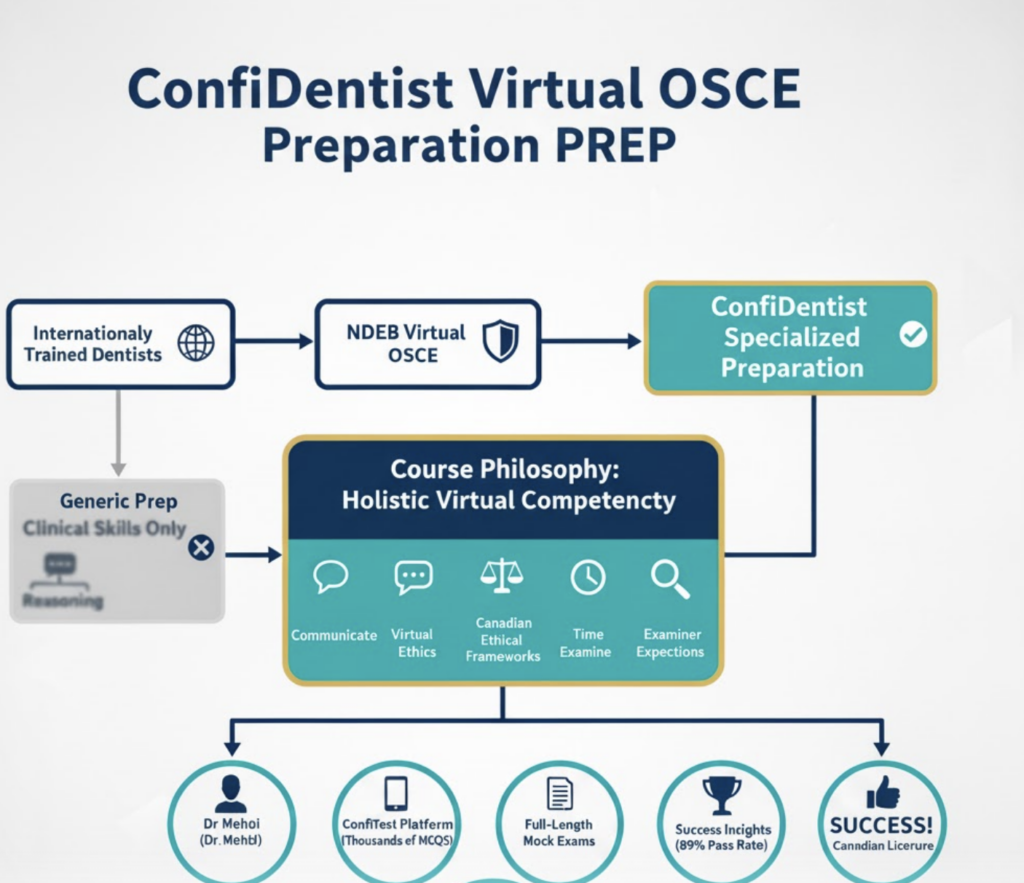
The course philosophy recognizes that Virtual OSCE success requires more than clinical dental knowledge—you need specific preparation in translating clinical reasoning into effective written/recorded responses, demonstrating professional communication within virtual format constraints, applying Canadian ethical frameworks to complex scenarios, managing time pressure while showing thorough clinical thinking, and understanding exactly what examiners seek when evaluating competency. ConfiDentist’s specialized curriculum addresses all these dimensions through systematic instruction, extensive practice with realistic scenarios, and strategic examination approaches proven effective through hundreds of successful students.
What distinguishes ConfiDentist’s Virtual OSCE courses from alternative preparation approaches is the combination of expert instruction from Dr. Mehdi (licensed Canadian dentist with extensive NDEB examination expertise), the proprietary ConfiTest platform providing thousands of solved MCQs specifically aligned with Virtual OSCE competencies, full-length mock examinations precisely mirroring actual Virtual OSCE format and difficulty, detailed discussion sessions analyzing mock performance and common pitfalls, and insights from recent successful candidates who share first-hand examination experiences and effective strategies. This comprehensive approach produces 89% first-attempt pass rates—substantially exceeding rates among candidates attempting the Virtual OSCE without specialized preparation.
Virtual OSCE Full Courses (March & May 2026)
Course Investment: $2,099.00 CAD
ConfiDentist’s full Virtual OSCE preparation courses for March 2025 and May 2025 examination dates provide comprehensive training through structured timelines aligning with NDEB examination schedules. These courses suit candidates who’ve recently passed their ACJ examination or are strategically planning Virtual OSCE preparation several months before their intended examination date.
8 Pre-Recorded Comprehensive Lectures:
Access to eight detailed pre-recorded lectures systematically covering all Virtual OSCE content domains and competency areas. These lectures address: clinical problem-solving and diagnostic reasoning approaches, comprehensive treatment planning and sequencing strategies, patient communication and informed consent best practices, professional ethics and challenging scenario analysis, medical emergency recognition and management protocols, special patient populations and accommodation requirements, interdisciplinary case management and appropriate referral criteria, and evidence-based clinical decision-making frameworks. Pre-recorded format allows flexible viewing according to your schedule, with ability to pause, replay, and review challenging content as needed.
Mock Exam Discussion Sessions:
Following each mock examination, ConfiDentist conducts extended discussion sessions (2-3 hours) reviewing commonly missed questions, analyzing why incorrect responses fail to demonstrate required competencies, explaining optimal response approaches showing strong clinical reasoning, discussing time management strategies for complex scenarios, and addressing student questions about specific cases or concepts. These collaborative review sessions help you understand not just what you answered incorrectly but why—teaching you to recognize examination patterns and improve strategic response approaches. Many students report these discussion sessions provide breakthrough insights that dramatically improve subsequent mock performance.
Virtual OSCE November 2025 Course
Course Investment:
$2,199.00 CAD
The November 2025 Virtual OSCE course offers enhanced preparation for candidates scheduling this fall examination date, featuring extended practice opportunities through additional mock examinations and discussion sessions beyond the standard full course format.
Enhanced Course Features:
This November course includes all components of the standard full course (1 live + 8 pre-recorded lectures, ConfiTest MCQ platform access, comprehensive study materials) plus enhanced practice testing and review: 3 Full Online Mock Examinations (200 questions each) instead of the standard 2 mocks, providing an additional comprehensive practice cycle allowing more thorough weak area identification and remediation verification, and 6 Mock Discussion Sessions (versus 2 in standard courses) offering more extensive collaborative review of mock performance, additional examination strategy guidance, and increased instructor interaction supporting deeper learning.
Extended 2.5-Month Program Duration:
The November course operates on a 2.5-month timeline (approximately 10 weeks) allowing more gradual pacing compared to 2-month standard courses. This extended duration suits candidates who prefer less intensive weekly study commitments, need more time for comprehensive content coverage and practice integration, want additional practice examination cycles with adequate remediation time between mocks, or are preparing while managing demanding work or family obligations requiring more flexible timelines.
The additional mock examination and discussion sessions particularly benefit candidates who struggle with test anxiety (additional practice reducing examination stress), those who need extensive practice developing competency in virtual response formats, or anyone who failed previous Virtual OSCE attempts and needs thorough systematic remediation addressing identified weaknesses. The enhanced practice and extended timeline position this course as ConfiDentist’s most comprehensive Virtual OSCE preparation option.
Virtual OSCE March 2026 Course (Advanced Access)
Course Investment:
$2,499.00 CAD
ConfiDentist’s March 2026 course offers advanced-access enrollment for candidates planning ahead to the spring 2026 examination date, providing early registration benefits and extended preparation timeline compared to courses beginning closer to examination dates.
Advanced Access Benefits:
Early Enrollment Pricing Lock: Registering for the March 2026 course far in advance locks current pricing protecting against potential future fee increases, secures your enrollment spot before courses fill (ConfiDentist caps enrollment ensuring adequate instructor support for all students), and provides priority access to updated course materials and new content added throughout 2025 based on evolving examination patterns.
Extended Preparation Timeline:
Early enrollment allows beginning preparation 6-9+ months before your examination date, particularly beneficial for candidates who prefer very gradual preparation pacing, those still completing ACJ examination and wanting overlapping preparation, dentists managing demanding schedules requiring extended timelines, or anyone seeking maximum practice exposure through multiple course cycles. The extended timeline allows completing the full course content, then spending additional months on intensive practice and weak area remediation, potentially even auditing subsequent course offerings for additional instruction and practice opportunities.
Comprehensive Course Structure:
The March 2026 course includes all standard full course components (1 live + 8 pre-recorded lectures, ConfiTest platform, 2+ full mock exams with discussion sessions) with potential for additional content enhancements as NDEB updates Virtual OSCE requirements or formats throughout 2025. Students enrolled early receive all updates and new materials automatically without additional fees.
This advanced-access option suits strategic planners who prefer securing preparation resources well ahead of examination dates, candidates who’ve just passed ACJ and want immediate Virtual OSCE preparation initiation, or anyone seeking maximum preparation time and flexibility for thorough mastery of Virtual OSCE competencies.
Specialized Course Options and Add-Ons
Beyond the comprehensive full courses, ConfiDentist offers targeted preparation options for specific student needs:
Board Exam Booklet (OSCE):
Printed study booklets specifically compiled for Virtual OSCE preparation, featuring consolidated content summaries, key concept reviews, clinical scenario examples, and high-yield competency guidelines. These physical study materials complement digital course resources, providing portable reference materials for offline study and annotatable resources for personal note-taking. Booklets available as course add-ons or standalone purchases for students supplementing other preparation approaches.
Mock Exam Only Packages:
Streamlined packages providing access to 2 full Virtual OSCE mock examinations with discussion sessions without full course lecture content, priced at approximately $450.00 CAD. These mock-only options serve university dental students (DDS candidates) needing practice testing for academic OSCE assessments, candidates who’ve previously taken full courses but want additional mock examination exposure, or international dentists who’ve completed alternative preparation programs and need ConfiDentist’s high-quality mock examinations for readiness verification.
ConfiTest Platform Standalone Access:
Some students purchase standalone ConfiTest MCQ platform access for extended periods beyond course enrollment, allowing continued practice question exposure while awaiting examination dates or during post-course additional preparation periods. Platform-only access provides the thousands of solved MCQs and performance analytics without lecture content or mock examinations.
Why ConfiDentist Virtual OSCE Preparation Succeeds
The ConfiTest Platform Advantage
ConfiDentist’s proprietary ConfiTest MCQ platform represents a unique preparation resource unavailable through alternative Virtual OSCE preparation approaches, providing thousands of expertly crafted scenario-based questions specifically designed to develop the clinical judgment and professional decision-making competencies the Virtual OSCE examination evaluates.
Exam-Aligned Question Design:
ConfiTest questions aren’t generic dental MCQs testing factual recall—they’re carefully constructed scenario-based questions mirroring actual Virtual OSCE question formats, complexity levels, and competency evaluation approaches. Each question presents realistic clinical situations requiring you to demonstrate appropriate diagnostic reasoning, treatment planning judgment, professional decision-making, or ethical analysis through answer selection. The scenarios integrate patient medical histories, clinical findings, radiographic images, and contextual factors requiring comprehensive analysis rather than simple knowledge recall.
Comprehensive Explanations for Deep Learning:
Every ConfiTest question includes detailed explanations addressing not just why the correct answer demonstrates appropriate clinical competency, but crucially why each incorrect option represents suboptimal clinical judgment, professional decision-making errors, or violations of Canadian practice standards. These thorough explanations teach you to recognize the subtle distinctions between acceptable and unacceptable clinical approaches—exactly what Virtual OSCE examiners evaluate when scoring your responses. Many students report that carefully studying ConfiTest explanations provides as much learning value as formal lectures by teaching nuanced professional judgment that distinguishes competent from incompetent practice.
Performance Analytics Guiding Focused Study:
The ConfiTest platform tracks your performance across all competency domains the Virtual OSCE assesses—clinical reasoning, treatment planning, communication, ethics, medical management, etc.—generating detailed analytics showing your strongest competencies and areas requiring focused improvement. This data-driven approach allows surgical precision in weak area remediation, focusing study effort exactly where needed rather than wastefully reviewing already-strong competencies. Performance trends over time confirm improvement trajectory and readiness development as examination approaches.
Adaptive Learning and Spaced Repetition:
ConfiTest employs sophisticated algorithms ensuring optimal question exposure timing for maximum retention. Questions you answer incorrectly reappear more frequently than those mastered, ensuring persistent weak areas receive necessary repetition. Correctly answered questions return at increasing intervals (spaced repetition) optimizing long-term memory consolidation without wasteful over-review of already-mastered content. This adaptive approach maximizes learning efficiency compared to random or linear question progression.
Mobile Accessibility for Study Flexibility:
The ConfiTest platform operates seamlessly across desktop computers, tablets, and smartphones, allowing practice question completion during brief periods throughout your day—lunch breaks, commutes, waiting rooms, evening relaxation time—rather than requiring dedicated study sessions at a desk. This flexibility helps candidates managing demanding schedules accumulate substantial practice volume through distributed micro-study sessions that might otherwise go unused.
Expert Instruction from Dr. Mehdi and Successful Candidate Insights
The quality of instruction fundamentally determines Virtual OSCE preparation effectiveness, distinguishing ConfiDentist’s courses through Dr. Mehdi’s expertise and integration of insights from recent successful candidates who’ve navigated the examination recently.
Dr. Mehdi’s NDEB Expertise:
As ConfiDentist’s lead Virtual OSCE instructor, Dr. Mehdi brings extensive experience preparing international dentists specifically for NDEB examinations rather than generic clinical skills teaching. His specialized knowledge encompasses deep familiarity with Virtual OSCE examination structure, format evolution, and competency assessment approaches; thorough understanding of how Canadian professional practice standards differ from international norms; recognition of common conceptual gaps and mistakes internationally trained dentists make; proven teaching methodologies addressing diverse learning needs and anxiety management; and genuine commitment to international dentist success reflecting personal understanding of licensure challenges.
Dr. Mehdi’s instruction goes beyond content delivery to include strategic examination preparation, how to analyze scenarios efficiently within time constraints, what specific language and response structures demonstrate competency effectively, how to handle ambiguous situations without clear right answers, and what examiners look for when differentiating competent from incompetent responses. This meta-cognitive instruction about the examination itself proves as valuable as clinical content for many students.
Recent Successful Candidate Contributions:
ConfiDentist regularly invites recent Virtual OSCE successful candidates like Dr. Natalia to share first-hand examination experiences, effective preparation strategies they employed, specific challenges they faced and overcame, actual examination surprises and how they managed them, and practical advice for future candidates. These peer insights provide authenticity and relatability that instructor teaching alone cannot. Successful candidates remember exactly what preparation felt like, what anxiety they experienced, what worked and what didn’t in their study approaches, and what the actual examination day involved.
The combination of expert instruction and peer experience creates comprehensive preparation addressing both the “what” (clinical content and competencies) and the “how” (effective study strategies, anxiety management, and examination performance optimization) of Virtual OSCE success. Students benefit from Dr. Mehdi’s pedagogical expertise while gaining practical wisdom from candidates who recently sat exactly where they currently sit.
Comprehensive Mock Examinations and Discussion Sessions
Perhaps the most valuable component of ConfiDentist’s Virtual OSCE preparation is the extensive mock examination system with detailed collaborative review—an evidence-based preparation approach that consistently produces superior outcomes compared to content study alone:
Full-Length Mock Exam Realism:
ConfiDentist’s mock examinations precisely replicate actual Virtual OSCE format, timing, question types, difficulty level, and competency assessment approaches, providing practice under conditions closely mirroring the real examination. This realism serves multiple crucial functions: desensitizes candidates to examination stress through repeated exposure reducing anxiety, develops time management skills for pacing through stations efficiently, identifies specific competency weaknesses requiring remediation while time remains, confirms readiness through consistent strong performance indicating examination preparedness, and builds confidence through successful completion of realistic challenges.
The 200-question mock examinations 2-3 per course depending on package) ensure comprehensive competency assessment across all Virtual OSCE domains rather than superficial sampling. This extensive practice volume allows pattern recognition developmentyou begin recognizing question types, common scenario structures, and effective response approaches through repeated exposure that dramatically improves examination performance.
Extended Discussion Sessions as Active Learning:
Following each mock examination, ConfiDentist’s 2-3 hour discussion sessions transform the practice test from simple assessment into powerful learning opportunity. These sessions employ active learning principles proven most effective for knowledge retention and competency development: collaborative analysis of challenging questions with instructor guidance, peer discussion allowing learning from classmates’ reasoning and mistakes, explicit articulation of clinical reasoning processes reinforcing proper thinking patterns, and immediate feedback correcting misunderstandings before they become ingrained.
Discussion sessions address commonly missed questions across the student cohort, identifying patterns in where internationally trained dentists struggle and why. For example, if many students miss questions involving informed consent protocols, the session explores Canadian consent requirements in depth, contrasts these with international norms, and provides specific strategies for approaching consent questions effectively. This targeted teaching addresses shared weaknesses more efficiently than individual study.
Performance Tracking Across Multiple Mocks:
Taking multiple mock examinations throughout your preparation allows tracking improvement trajectory over time, the most reliable indicator of readiness. Students typically show 15-25% performance improvement from first to final mock examination, demonstrating systematic competency development. This measured progress provides both motivation (seeing tangible improvement rewards continued effort) and readiness confirmation (consistent 75-80%+ performance on final mocks indicates strong examination preparedness).
The mock examination system also reveals whether your preparation approach works effectively. If performance plateaus or declines across multiple mocks, this signals need for strategy adjustments, perhaps studying ineffective topics, using inefficient study methods, or experiencing burnout requiring rest. Course instructors help interpret performance patterns and guide necessary adjustments ensuring continued improvement.
Strategic Focus on Canadian Professional Competencies
Virtual OSCE success requires more than clinical dental knowledge—you must demonstrate specifically Canadian professional competencies that may differ significantly from international practice norms.
ConfiDentist’s courses emphasize these Canadian-specific elements throughout instruction:
Canadian Communication and Consent Standards:
The Virtual OSCE heavily emphasizes patient communication effectiveness and appropriate informed consent processes reflecting Canadian healthcare values. ConfiDentist’s preparation addresses Canadian expectations for patient-centered communication (collaborative rather than paternalistic), comprehensive informed consent including risks, benefits, alternatives, and costs, plain language explanations without excessive jargon, cultural sensitivity and accommodation, and patient autonomy respect even when disagreeing with patient decisions. Many internationally trained dentists from hierarchical healthcare cultures require specific preparation in Canadian collaborative communication approaches.
Canadian Ethical Frameworks and Professional Judgment:
Clinical scenarios often include ethical dilemmas without clear right/wrong answers, assessing your professional judgment and ethical reasoning processes. ConfiDentist teaches Canadian ethical frameworks emphasizing patient autonomy, informed decision-making, confidentiality and privacy protection, professional boundaries, and evidence-based practice over personal preference. The instruction helps you recognize ethical dimensions in clinical scenarios and demonstrate appropriate professional judgment even in ambiguous situations where multiple approaches might be defensible.
Evidence-Based Canadian Practice Standards:
Treatment planning questions assess whether your clinical approaches align with current Canadian evidence-based practice guidelines rather than outdated techniques or international practice variations. ConfiDentist’s instruction emphasizes contemporary Canadian clinical practice standards, when conservative management supersedes aggressive treatment, appropriate specialty referral criteria, and recognition that “how we learned it” internationally may not match “how Canadians practice.” This updating proves essential for dentists who graduated years ago or trained in programs emphasizing different clinical philosophies.
Cultural Competence and Diversity Awareness:
The Virtual OSCE assesses cultural competence through scenarios involving diverse patient populations—different cultural backgrounds, languages, health literacy levels, socioeconomic situations, and special needs. ConfiDentist prepares candidates to demonstrate appropriate cultural sensitivity, recognize when interpreter services or accommodation are needed, avoid cultural assumptions or stereotypes, and provide patient-centered care respecting individual circumstances. This competency proves particularly important given Canada’s multicultural society and healthcare system values.
Student Success Outcomes and Performance Data
ConfiDentist Virtual OSCE Pass Rates vs National Averages
ConfiDentist’s Virtual OSCE preparation courses consistently produce first-attempt pass rates substantially exceeding NDEB examination benchmarks, demonstrating program effectiveness in preparing internationally trained dentists for this challenging clinical competency assessment:
89% First-Attempt Success Rate:
Among students completing ConfiDentist’s full Virtual OSCE courses (attending live sessions, finishing pre-recorded lectures, completing recommended ConfiTest practice volume, and taking all mock examinations), 89% pass their Virtual OSCE on first attempt—a remarkable outcome considering the examination’s difficulty and the challenge of demonstrating clinical competency through virtual formats rather than traditional hands-on assessment.
Substantial Advantage Over Alternative Preparation:
While NDEB doesn’t publish specific Virtual OSCE pass rates, analysis of candidate experiences and NDEB equivalency completion data suggests national first-attempt Virtual OSCE pass rates approximate 65-70%—meaning roughly one-third of candidates fail initially despite having passed both written NDEB examinations. ConfiDentist students demonstrate approximately 20-percentage-point advantage over these estimates, representing hundreds of candidates who achieve first-attempt success through systematic preparation versus failing without specialized training.
Consistent Performance Across Diverse Backgrounds:
The 89% success rate maintains consistency across students from varied origin countries, different years since graduation, diverse clinical experience levels, and ranging English language proficiency. This consistency demonstrates that ConfiDentist’s preparation methodology succeeds regardless of starting competency levels—the systematic approach builds required capabilities through comprehensive instruction and extensive practice rather than assuming particular foundational strengths.
Second-Attempt Success for Initial Failures:
Among the 11% of ConfiDentist students who don’t pass their first Virtual OSCE attempt (often due to excessive test anxiety, inadequate mock completion, or examination day technical issues), focused remediation with additional course support produces approximately 92% second-attempt success. This high second-attempt rate indicates that even initial failures typically reflect correctable preparation gaps or performance issues rather than fundamental competency inadequacy requiring extensive additional clinical training.
What Successful Virtual OSCE Candidates Do Differently
Analysis of performance patterns among ConfiDentist’s highest-scoring Virtual OSCE students reveals specific preparation and examination strategies consistently correlating with exceptional outcomes:
Extensive ConfiTest Practice Volume:
The single strongest predictor of Virtual OSCE success is completion of high practice question volume through the ConfiTest platform. Students who complete 2,000+ ConfiTest MCQs during preparation demonstrate dramatically higher pass rates compared to those completing fewer than 1,000 questions. Extensive practice develops pattern recognition for question types, reinforces clinical reasoning processes through repeated application, reveals persistent competency weaknesses requiring focus, and builds confidence through demonstrated mastery across diverse scenarios.
Active Engagement with All Course Components:
Students who attend live sessions or watch recordings promptly, complete all pre-recorded lectures taking comprehensive notes, finish all mock examinations under timed conditions, and actively participate in discussion sessions asking questions achieve significantly higher success rates (93%) compared to students who selectively engage with only some course elements (78%). Complete engagement ensures no dangerous knowledge or competency gaps that examination scenarios might expose.
Thorough Mock Exam Review and Remediation:
How students handle mock examination results powerfully predicts actual examination outcomes. Successful candidates spend substantial time reviewing all mock questions, particularly those answered incorrectly, understanding not just right answers but why their original responses demonstrated inadequate competency, identifying patterns in their mistakes revealing conceptual misunderstandings or competency gaps, and systematically remediating identified weaknesses before subsequent mocks or actual examination. Unsuccessful candidates often review mock results superficially, note their scores without deep analysis, and repeat identical mistakes across multiple practice cycles.
Strategic Response Development Skills:
Virtual OSCE success requires not just knowing correct clinical approaches but demonstrating that knowledge effectively through responses examiners can evaluate. Successful students develop strategic response formulation skills: using clear organized structure in written responses, including specific justifications showing clinical reasoning, demonstrating patient-centered thinking in communication scenarios, and explicitly addressing all competency dimensions each question evaluates. These response skills are teachable and improvable through practice—high performers invest time refining how they demonstrate competency beyond just knowing what competent approaches are.
Appropriate Anxiety Management:
Some examination anxiety motivates productive preparation, but excessive anxiety undermines Virtual OSCE performance. Successful candidates who recognize problematic anxiety employ specific management techniques: regular mock testing desensitizing them to examination pressure, mindfulness and breathing exercises maintaining calm during actual examination, cognitive restructuring challenging catastrophic thinking patterns, and realistic performance expectations (passing requires competency demonstration, not perfection). ConfiDentist’s courses include anxiety management guidance for students needing this support.
Time Management Discipline:
Virtual OSCE stations impose strict time limits requiring efficient scenario analysis and response completion. Successful students develop disciplined time management during practice: reading scenarios strategically to identify key information quickly, allocating time proportionally across multiple questions within stations, avoiding excessive rumination on ambiguous questions, and completing all required responses even if uncertain rather than leaving sections blank. These time management skills transfer directly to examination success.
Success Stories from Virtual OSCE Course Graduates
“After passing AFK and ACJ, I naively assumed the Virtual OSCE would be straightforward since I’d been practicing dentistry for 8 years in India. The first mock examination crushed that assumption. I scored barely 60%, far below passing threshold. ConfiDentist’s course taught me that Virtual OSCE success requires demonstrating clinical competency in specifically Canadian professional contexts, not just possessing dental knowledge. The ConfiTest platform practice and discussion sessions transformed my performance—by my final mock I scored 81%. I passed my actual Virtual OSCE comfortably and am now completing my licensing requirements in Ontario.”
Dr. Rajesh Patel
International Dental Graduate (India, 8 years practice experience) | Completing Ontario Licensure
“The Virtual OSCE format initially terrified me—how do you demonstrate clinical skills through a computer? ConfiDentist’s specialized preparation made all the difference. The mock examinations precisely replicated actual examination format and difficulty, allowing me to develop comfort and confidence with the virtual assessment approach. Dr. Mehdi’s teaching helped me understand what examiners look for when evaluating competency through scenario responses. I passed on my first attempt and credit ConfiDentist’s exam-specific preparation for my success.”
Dr. Maria Santos
International Dental Graduate (Philippines) | Licensed Dentist, British Columbia
“After failing my first Virtual OSCE attempt through minimal preparation, I invested in ConfiDentist’s comprehensive course for my second attempt. The difference was night and day. The structured instruction addressed specific competency gaps I didn’t know I had, the ConfiTest platform provided the extensive practice I’d neglected initially, and the mock discussion sessions taught me strategic response approaches I’d missed entirely on my first attempt. I passed my second Virtual OSCE with substantially higher scores and finally achieved my Canadian dental license. Don’t make my mistake of attempting this examination without proper specialized preparation.”
Dr. Ahmed Hassan
International Dental Graduate (Pakistan) | Licensed Dentist, Alberta (after specialized preparation)