
The 5 Competencies the SJC Evaluates
Our course trains each competency individually before combining them into full scenario practice.
Patient Communication
Explaining diagnoses, treatment options, and risk clearly and empathetically.
Ethical Reasoning
Navigating conflicts of interest, confidentiality, and professional boundaries.
Interprofessional Collaboration
Working with hygienists, specialists, and other healthcare providers appropriately.
Informed Consent
Ensuring patients understand and agree to treatment with full transparency.
Adverse Situation Handling
Responding to complications, mistakes, or high-stakes moments professionally.
Course Structure
| Component | Details |
|---|---|
| Format | Live scenario workshops + recorded competency modules |
| Duration | Structured multi-week cycle, one competency focus per week |
| Practice format | Written + verbal scenario responses with instructor scoring |
| Mock exams | Full-length, rubric-graded scenario simulations |
| Feedback | Individual, response-by-response instructor review |
| Ideal for | Candidates who have passed ACJ and are eligible for NDECC registration |
Replace table values with your actual 2027 cycle schedule, pricing tier, and cohort dates before publishing.
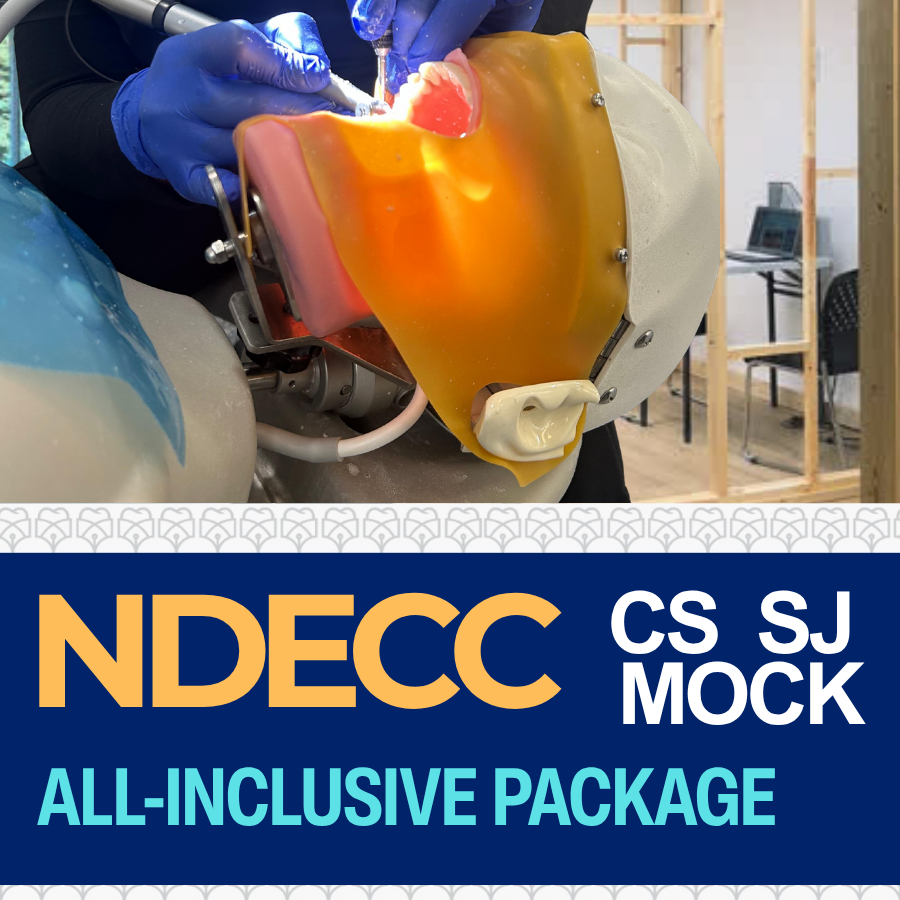
Situational Judgement vs. Clinical Skills
Situational Judgement (SJC): scenario-based, evaluates communication, ethics, and professional decision-making.
Clinical Skills (CSC): hands-on, manikin-based, evaluates technical dental execution against a strict rubric.
Most candidates need to prepare for both — see our NDECC Clinical Skills course or the NDECC Bundles for combined prep.
Frequently Asked Questions
What is tested in the NDECC Situational Judgement Component?
The SJC evaluates professional judgement through realistic scenarios covering patient communication, ethical reasoning, interprofessional collaboration, informed consent, and handling of adverse situations.
Is the NDECC Situational Judgement exam written or verbal?
The SJC includes both written and scenario-based response formats, depending on the specific station — our course trains candidates in both formats.
How is the Situational Judgement Component graded?
Responses are scored against how closely they reflect the professional standard expected of a practicing dentist in Canada, rather than simply identifying the “correct” clinical answer.
Do I need to pass Clinical Skills before taking Situational Judgement?
The Clinical Skills and Situational Judgement Components are both part of the NDECC and are typically taken together — both must be passed to complete the NDEB Equivalency Process.
Why do candidates with strong clinical knowledge still fail the SJC?
The SJC tests communication, ethics, and professional judgement — not clinical knowledge. Candidates who answer with technically correct but impersonal or vague responses often lose points that structured scenario practice can address.