
The ConfiDentist NDECC Clinical Skills 2027 Program
Every session builds toward the exact five grading dimensions the NDEB uses to score the CSC.
Full Simulator Lab Access
Identical manikin systems to the NDECC Test Centre, with extended lab hours to build real muscle memory.
Rubric-Calibrated Feedback
Every submission reviewed against the five official grading criteria by instructors who've passed the CSC.
Timed Station Simulation
Weekly mock sessions replicate real exam timing so pacing becomes second nature.
Infection Control Drilling
Dedicated sessions on Canadian protocol — one of the most avoidable point losses.
Examiner-Modeled Demos
Live and recorded demos showing exactly what a passing performance looks like, station by station.
Course Structure
| Component | Details |
|---|---|
| Format | In-person lab + live/recorded lectures |
| Duration | Structured multi-week cycle with progressive skill-building |
| Lab access | Extended hours, multiple sessions per week |
| Mock exams | Full-length, rubric-graded simulations |
| Feedback | Individual, session-by-session instructor review |
| Ideal for | Candidates who have passed ACJ and are eligible for NDECC registration |
Replace table values with your actual 2027 cycle schedule, pricing tier, and cohort dates before publishing.
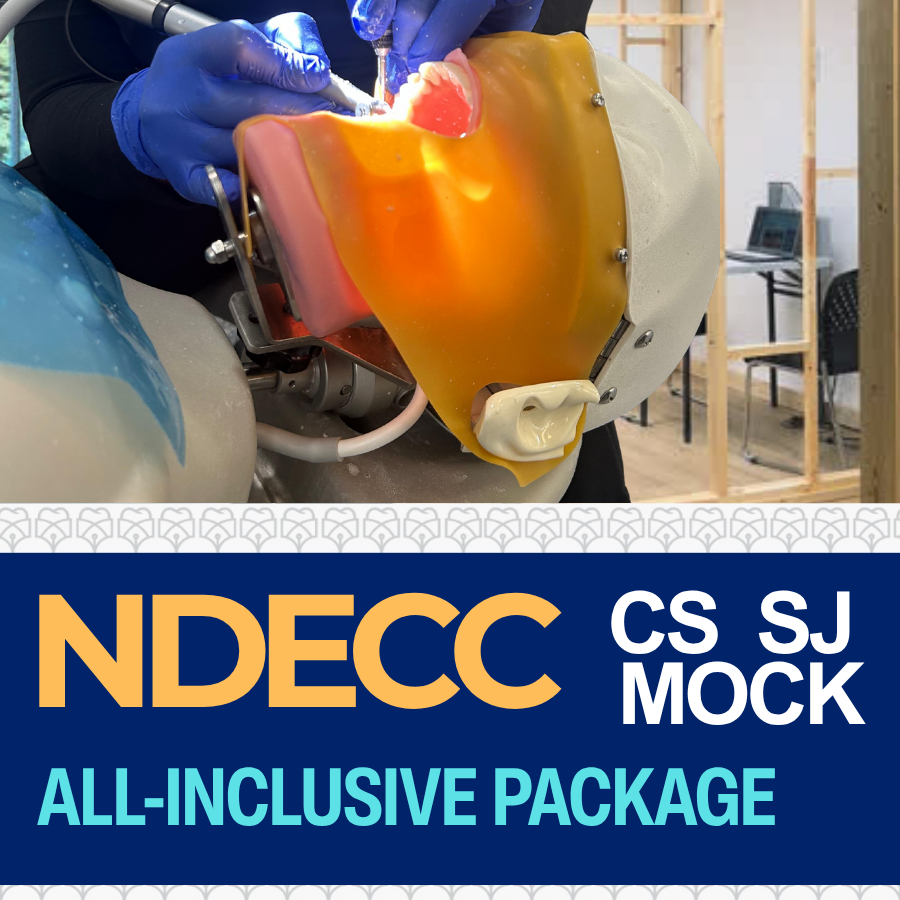
Clinical Skills vs. Situational Judgement
Clinical Skills (CSC): hands-on, manikin-based, evaluates technical dental execution against a strict rubric.
Situational Judgement (SJC): scenario-based, evaluates communication, ethics, and professional decision-making.
Most candidates need to prepare for both — see our NDECC Situational Judgement course or the NDECC Bundles for combined prep.
Frequently Asked Questions
What is tested in the NDECC Clinical Skills Component?
The CSC evaluates hands-on dental procedures performed on manikins, graded against five criteria: gross reduction, refinement, thoroughness, attention to detail, and caution, in line with Canadian clinical standards.
Where is the NDECC Clinical Skills exam held?
The NDECC is administered exclusively at the NDEB’s dedicated Test Centre in Ottawa, Ontario. There are no regional test locations.
How long does NDECC Clinical Skills preparation take?
Most candidates need a structured multi-week to multi-month program combining lab practice, rubric feedback, and timed mock sessions before they’re exam-ready.
Do I need to pass ACJ before taking the NDECC Clinical Skills exam?
Yes. The NDECC is the third gate in the NDEB Equivalency Process — candidates must pass the AFK and ACJ before becoming eligible to register for the NDECC.
What’s the difference between NDECC Clinical Skills and Situational Judgement?
Clinical Skills tests hands-on technical execution on manikins; Situational Judgement tests communication, ethics, and professional decision-making through scenario-based stations. Both must be passed.